

Running
Facilitator Training Program
A year long program, where young adivasis become equipped with the skills and the mindset to be leaders in their community
The goals of the project is to create a network of young adivasis who will
1) act as a support system for the 3000 adivasi school going children.
2) be equipped with the skills and mindsets to work with the their communities.
More about the project
Target group
We work with young adivasis between the age of 18 to 25 in the Gudalur and Pandalur regions of Nilgiris Bioreserve
Why we do it
Historically, VBVT has been riding piggy-back on the Adivasi Munnetra Sangam. This Sangam was started in 1988 to lead a land rights movement as a large number of adivasi people had been rendered landless for various reasons. This movement brought together five different tribes that inhabit the Gudalur valley – Paniya 40%, Bettakurumba 25%. Kattunayaka 15%, Irula 10% & Mullukurumba 10%. Under the umbrella of adivasis, these tribes came together not only to redeem their lost lands but also to redeem their lost cultures and languages.
Given this background, VBVT decided to undertake an education campaign with the help of the AMS. In 1999 VBVT did a baseline survey to find that the literacy levels was as low as 25% and within the tribes, the Kattunayakan was as low as 15%. VBVT decided to use the adivasi community members themselves to take this programme forward.
Given the fact that there were eleven residential schools meant exclusively for tribals and many other government schools in the vicinity of adivasi villages, VBVT along with the AMS initiated in the year 2000 a drive to put children in school. Starting with 138 of the 320 villages, it took as many as 15 years before we could safely say that the community now has become conscious of the need for schooling. By 2015, every child in every village was being admitted to school without any intervention from VBVT.
But to our great disappointment and alarm we found that only around 50% of the children who enrolled in class 1 were completing their studies in class 10. The government too recognised this and realised that schemes had to be taken up for this. They initially had two-year bridge courses run by NGOs – VBVT being one of them (ran two centres), which later converted into two residential schools each having 100 children, exclusively for drop-outs. But these do not prevent children from dropping out. Besides, the number of children dropping out every year was more than 200. For the community too this has been a great disappointment, because it has cost them a lot to send these children to school. It is obvious that these children left school because they could not relate to the system in any way. The relationship with unsympathetic teachers, quality of education, all these became major issues. The community had done their part – taking the children to the school, but beyond the threshold of the class-room they had no say and no knowledge as to what had to be done.
It is for these reasons, that we have identified a need to create a cadre of young adivasis both at the village level to act as support systems as well as become qualified teachers to enter into the education system.
Project activities
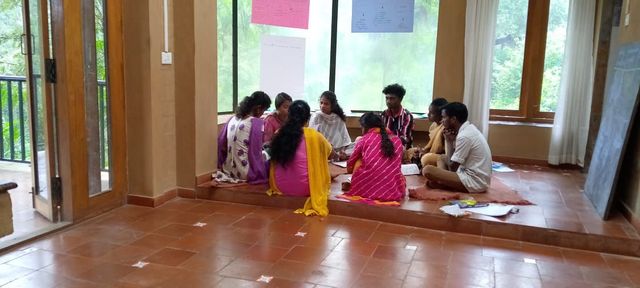
The Facilitator training program, is a yearlong initiative which aims to create young Adivasis who are motivated and equipped to work for social issues affecting them and their community using the tools and perspectives of education.
The training is divided into 3 phases, the first two phases are a residential and the third phase will happen through an experiential learning module
1) Phase 1: Understanding the self and the community we come from. The first phase is the foundational phase, where the young Adivasis start with exploring their life journeys and the identities they hold. Through this exploration they would build ways to understand the society around them and the necessary emotional skills needed to live in the society.
2) Phase 2: Understanding the role education plays in their life and how education can be a tool for social change. Through this they will be equipped with tools to work in their communities.
3) Phase 3: The third phase will be creating spaces for them to work in their communities and learning more about the topics touched upon the first two phases through a work based approach and regular reflections and exposures.